
Our Vision

"A World without Hunger and Injustice"

 Farming
ECOLOGICAL FARMING




ABOUT THE PROJECT :
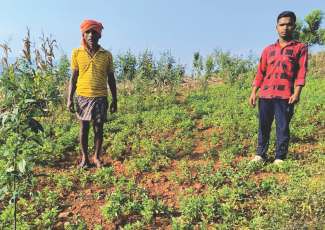
Farmers across several tribal villages are increasingly adopting zero-tillage farming and experiencing significant benefits. Youth farmers and eco-leaders were the first to demonstrate its success on their fields. Crops like brinjal, ragi, arhar, and various millets are growing healthy and vigorous under thick leaf and straw mulch. Even rocky and upland lands that were difficult to cultivate earlier are becoming productive. Initially skeptical farmers are now convinced after seeing improved crop growth and yields. Zero-tillage has reduced the need for ploughing, lowering labor and input costs. Recycling crop residues has helped improve soil moisture and fertility. Farmers also report fewer problems with pests, diseases, and crop failures. More families are transporting rice straw to their fields to use as mulch. Within a few months, visible positive changes are seen in the fields. Gradually, more patches of land are being brought under zero-till cultivation. The practice is emerging as a promising and sustainable farming approach in these regions.
In Agragamee Kashipur Campus, this year again, zero-till fields of little millet, finger millet, foxtail millet and pearl millet, black gram and rice bean bear testimony to the regenerative power of nature, when we go along with her, and do not fight her with plough, chemicals, etc. This is the 6th year of zero-till organic cultivation, and the each field is a thriving vigorous patch that holds out great promise. Neighbouring fields, beside the campus have not been cultivated for several years, as they have been subjected to erosion, overgrazing, and runoff.
Across the world today, soils are being lost at a frightening pace — every time the plough turns the earth, the living skin of the soil is torn apart. This top layer, rich with earthworms, fungi, and microscopic life, making the land fertile is not just a layer, it is a living, life giving world of which we humans are born. Forgetting this is a great mistake! When exposed to the sun, torn asunder with a plough and crushed under the tractor wheels, the soil dries and dies. When the rains come, this dead matter just gets washed away, losing any fertility it might still have.
This is the quiet crisis of our times: our soils are dying, and with them, the very foundation of our food and life systems. But zero-till offers a way back. It protects the soil with a cover of straw, leaves, and crop residue — feeding the microorganisms that in turn feed the plants. The soil begins to breathe again. The earthworms return. Water stays longer, weeds reduce, and crops thrive with less effort and cost.


